
Hunting Beyond Cell Coverage: How to Stay Reachable When Something Goes Wrong
Most hunting grounds have no cell service. Here's how to make sure someone knows where you are, and how to reach help if you need it.
Before you head out, leave a written trip plan with one specific person, agree on when they should start making calls, and carry a way to send a message that doesn't depend on a cell signal. Most hunting grounds have patchy coverage at best, and the hours when hunters are most likely to be moving, before dawn and after sunset, are also the hours when a problem is hardest to solve alone.
Where Cell Coverage Actually Ends
Coverage is reported by population, not by land. That single distinction explains most of the gap between what the maps promise and what hunters experience, a network reaching 99% of people can still leave most of the map uncovered.
In Canada, 99.5% of people had LTE coverage at the end of 2024, but by land area the largest national network reaches roughly 37% of the country. In the United States, when the FCC drive-tested carrier coverage claims against reality, only 62.3% of rural test runs hit the speeds the maps promised.
Both regulators, independently, have found the same thing: reported coverage runs ahead of real coverage, and the gap is widest exactly where hunters go.
What "coverage" actually measures
Population
- What it describes: People who can get a signal where they live
- Why it misleads hunters: Canadians who can get an LTE signal where they live
Major roads and highways
- What it describes: Major routes with service
- Why it misleads hunters: Hunting starts where the pavement ends
Land area
- What it describes: Physical ground inside a footprint
- Why it misleads hunters: The only one that describes where you'll sit and the one nobody advertises
Carrier maps are also predictions rather than measurements. They're built from propagation models submitted by the carriers themselves, which is why terrain undoes them so quickly. A valley, a ridge between you and the tower, or heavy canopy can take you from three bars to nothing without you moving far.
What makes it more dangerous
Hunting Alone: No One to Go for Help
Plenty of people hunt alone, and there's nothing wrong with it. It does change the maths on everything else.
Alone in the field, small things take longer to sort out and there's nobody to notice if you're not where you expected to be. The answer isn't to stop hunting alone. It's to make sure someone at home knows enough to notice.
That's what a Safety Circle is. Someone at home holds the trip plan, knows your check-in times, and knows the hour at which they stop waiting and start calling. You're alone in the field. You're not alone in the plan.
It only works if both halves are set up. Agreed check-in times, a plan somebody is actually watching rather than one that's sitting in a text message, and a way to signal that doesn't require you to walk anywhere.
Injured and Immobile: When You Can't Get Yourself Out
The injuries that actually send hunters to hospital aren't the ones most people picture. Canada doesn't track hunting injuries nationally, but in the United States, where the data is collected, a nine-year study of big game hunters in Colorado found that cardiac disease and lacerations sustained while field dressing were the leading reasons for emergency treatment. Gunshot wounds accounted for under 1% of cases.
The reasons carry across the border, and arguably weigh heavier here. Hunting is often the most demanding physical exertion someone attempts all year, and it stacks the risks: cold constricts blood vessels, the terrain is uneven and usually uphill on the way back, adrenaline spikes on sighting an animal, and then there's the drag out, a moose being a considerably harder proposition than a whitetail. Add a bad fall on wet rock, a slip with a sharp blade in cold hands, or an ATV or boat problem on the way in or out, and the pattern is the same: someone who can't get themselves out, in a place where a phone won't work.
Cold is what turns that from a difficult afternoon into an emergency, because a person who can't move stops generating heat. Time is the other factor, and rural response is slower everywhere it's been measured. None of that clock starts until somebody knows.
What that actually costs you
What Happens When Nobody Hears From You
This is the part almost nobody thinks through, and it's the reason all of the above matters.
Picture the sequence. You said you'd be back by dark. Dark comes. Your partner waits, because you've been late before. An hour passes. They try your phone and it goes to voicemail, which tells them nothing, because it always goes to voicemail out there. They start calling friends to ask whether anyone's heard from you. Eventually somebody calls the local detachment.
Then the search has to start from whatever information exists. If nobody knows your access point, the area to cover might be tens of square kilometres of bush, in the dark, in the cold.
Every step of that is hours. The value of being reachable isn't dramatic rescue. It's collapsing that timeline — either because you sent a message and nobody had to guess, or because your last known location was shared and searchers had somewhere to start.
What you do about it
The Hunting Trip Plan (+ Template)
A trip plan is the single most useful thing you can do before leaving, and it takes about four minutes.
Give one named person, not a group chat, not a passing mention, the following:
- Where you're going, as specifically as you can put it
- Which access point you're using and where the vehicle will be parked
- Who's with you, if anyone
- When you expect to be back
- The time at which they should start making calls
That last line is the one people leave out, and it's the one that matters most. Without it, the person at home spends hours deciding whether it's too early to worry. With it, there's no decision to make. They just look at the clock.
If your plans change during the day, meaning different spots, staying later, moving to another area, tell them. A trip plan that's out of date is worse than none at all, because it sends people to the wrong place.
Download ZOLEO Trip Plan ➔
Set Up a Way for Your Family to Reach You
Here's the part most hunters underestimate: it's not only about you calling out. It's about your family reaching in.
Something happens at home. A parent goes into hospital, a kid gets hurt, a pipe bursts. If you're four days into a camp with no signal, your partner has no way to tell you, and no way to know whether you've received anything.
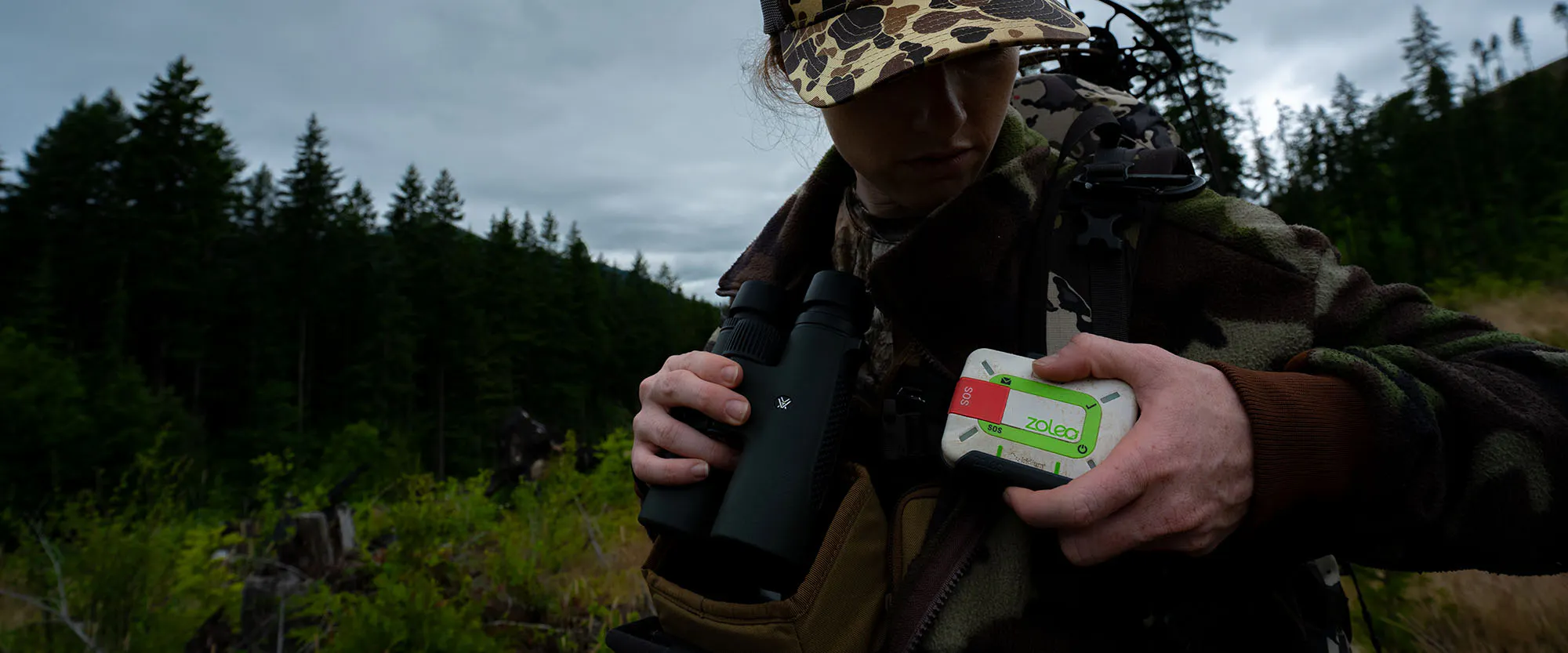
This is where a satellite communicator earns its place, and where the differences between them matter. ZOLEO gives you a dedicated SMS number and email address. Your partner texts that number from their ordinary phone. They don't install an app, don't create an account, don't learn anything new. From their side it looks like texting you normally, and the message finds you over satellite, cell or Wi-Fi depending on what's available.
That matters more than it sounds. The safety plan that works is the one the least technical person in your household can use under stress.
Get Medical Advice Without Calling an SOS
Most of what goes wrong on a hunt sits in the gap between fine and emergency.
A cut that's deeper than you expected. A joint that's swelling. None of those obviously warrant an SOS, and hunters are reluctant to trigger one, so people wait, and sometimes they wait too long.
The honest question is who you ask.
ZOLEO includes Medical Assist for situations like these, 24/7 access to non-emergency medical advice through the app, separate from SOS. Your enquiry is answered by medical professionals, with your GPS coordinates included. Responses may take up to 10 minutes.
Get a Weather Forecast for Where You Actually Are
Hunters watch weather more closely than almost anyone. Wind direction, a front moving through, a pressure drop, it changes where you sit and when you move.
The problem is that the forecast you checked before leaving was for the nearest town, which may be an hour away and several hundred metres lower. The ZOLEO app pulls weather forecasts for a specific location, including where you are, without needing a cell signal.
The safety use is obvious: knowing a front is arriving before it does gives you the option to move early. The everyday use is why people actually open it.
Your Pre-Season Checklist
- Check your signal where you sit, not at the vehicle. Note where it dies.
- Add a suspension relief strap and practise using it at ground level.
- Walk your route in daylight and mark the way in and out.
- Write the trip plan and give it to one named person, including the escalation time.
- Pack to stay put, not just for the day — emergency layer, fire source, headlamp with spare batteries, water, food, first aid kit.
- Check this year's provincial regulations. Seasons, zones, licensing and high-visibility requirements differ by province and change annually.
- Agree your check-in times with whoever's watching.
- Get your ZOLEO ready. Charge it, confirm the app is updated and paired, send a check-in from a clear view of the sky, review who's in your Safety Circle, your friends, family and loved ones and confirm your service is active now rather than at the trailhead.
How ZOLEO Fits Into a Hunting Plan
ZOLEO is a Safety and Preparedness Platform. On a hunt, its job is to keep you in contact with your Safety Circle, your friends, family and loved ones and to give you a way to reach emergency assistance if you need it, when used with an active service plan.
It doesn't replace a trip plan, warm layers, a first aid kit or good judgment, and no device guarantees a particular outcome. Satellite communication needs a clear view of the sky, so heavy canopy or a deep draw can prevent a connection. It also doesn't navigate for maps and routing, you're still using your phone or a dedicated GPS.
What it does is remove the assumption underneath every other piece of safety advice: that somebody will find out something has gone wrong.
Frequently asked questions
Will my phone work where I hunt?
Often not. Coverage maps are drawn around roads and towns, and terrain can take you from a usable signal to nothing within a short distance. Check at the spots you actually hunt rather than trusting the map.
How much of North America actually has cell coverage?
It depends what you're measuring. In Canada, 99.5% of people had LTE coverage at the end of 2024, but by land area the largest network reaches roughly 37% of the country. In the United States, FCC drive tests found only 62.3% of rural runs met the speeds carrier maps promised. Population coverage and ground coverage are very different numbers.
How many people hunt in North America?
Around 15.2 million licensed hunters in the United States as of 2024, and roughly 1.3 million in Canada. About 80% of US hunters pursue big game, with deer the most common, roughly 8.1 million deer hunters. Participation is highest in Montana, Wyoming, South Dakota, Wisconsin and Idaho, each above 15% of the population.
Why does my phone lose signal when the coverage map says I should have service?
Coverage maps are built from propagation models submitted by carriers — predictions rather than measurements. Terrain, canopy and distance all reduce the real signal below the modelled one. Both the FCC and the CRTC have found that reported coverage overstates what people actually experience.
What should I tell someone before I go hunting alone?
Where you're going, the access point and where the vehicle will be, when you expect to be back, and the time at which they should start making calls. Written down, given to one named person.
What causes the most hunting injuries?
Not what most people picture. Data on big game hunters shows cardiac events and cuts sustained while field dressing lead emergency department visits, with gunshot wounds accounting for under 1% of cases.
How long does it take for someone to start looking for me?
Longer than most people expect. Without an agreed escalation time, the person at home spends hours deciding whether to worry, then more time working out who to call. Agreeing the time in advance removes that delay.
Can I get help without triggering an SOS?
With ZOLEO, yes. Medical Assist is a separate 24/7 channel for non-emergency medical questions, answered by medical professionals. It's available with an active ZOLEO subscription, and responses may take up to 10 minutes.
Does ZOLEO work as a GPS for navigation?
ZOLEO shares your location with your Safety Circle, your friends, family and loved ones and sends GPS coordinates with an SOS, but it isn't a mapping or navigation device.
Sources
Coverage — United States
FCC, MF-II Coverage Maps Investigation Staff Report (December 2019) — drive-test findings; 62.3% of rural runs meeting promised speeds; conclusion that submitted data likely overstated actual coverage.
FCC National Broadband Map — mobile coverage data and downloads. https://broadbandmap.fcc.gov
Coverage — Canada
Canadian Telecommunications Association — 99.5% of Canadians with LTE coverage as of end 2024. https://canadatelecoms.ca/industry_data/mobile-coverage-across-canada/ CRTC, Canadian Telecommunications Market Report 2025 — 87% of major roads and highways; the Commission's observation that complaints and public research indicate more gaps than providers report. https://crtc.gc.ca/eng/publications/reports/PolicyMonitoring/2025/ctmr.htm WhistleOut Canada — carrier landmass coverage. https://www.whistleout.ca/CellPhones/Guides/Coverage ISED / Open Government, National Broadband Data. https://open.canada.ca/data/en/dataset/00a331db-121b-445d-b119-35dbbe3eedd9
Hunting participation
U.S. Fish & Wildlife Service, National Survey of Fishing, Hunting and Wildlife-Associated Recreation — hunter numbers, big game share, deer hunter numbers.
Archery Trade Association, state-by-state hunting data — state participation rates. https://archerytrade.org/state-by-state-hunting-data/ Government of Ontario via Statista — deer tag holders. https://www.statista.com/statistics/1335963/number-hunting-tag-holders-ontario-canada-by-animal/ BC Outdoors Magazine — BC licensed hunters; national hunter estimate. https://www.bcoutdoorsmagazine.com/the-future-of-hunting/ Made in CA — Quebec licence volume. https://madeinca.ca/fishing-and-hunting-tourism-statistics-canada/
Injury
Injuries and Illnesses of Big Game Hunters in Western Colorado: A 9-Year Analysis, Wilderness & Environmental Medicine.
Disclaimers:
General information only. This article is provided for general informational purposes and is not a substitute for professional training, medical advice, or the judgment of qualified emergency services. Always follow local regulations and seek professional help in an emergency. No communication device can guarantee connectivity, response, or a particular outcome.
SOS & Emergency Response Coordination: SOS alerts are monitored by a third-party emergency response coordination provider. ZOLEO is not a licensed emergency dispatch service and does not guarantee rescue, response, evacuation, medical assistance, security assistance, search and rescue availability, or coordination with local emergency authorities. Emergency response, rescue, evacuation, medical, security, and related services are subject to satellite connectivity, applicable laws and regulations, local emergency response capabilities, geographic location, environmental conditions, and third-party service availability. Additional third-party costs may apply. SOS should be initiated only in the event of an actual emergency.
Coverage & Connectivity: Satellite communication requires a clear view of the sky. Connectivity is not guaranteed and may be affected by satellite availability, terrain, weather, environmental conditions, device positioning, and other factors outside ZOLEO's control. Coverage details apply.
Subscription Required: Active subscription required. An active ZOLEO subscription plan is required to transmit messages or use connected features over the Iridium satellite network.
Legal/Jurisdictional: Some jurisdictions regulate or prohibit the use, possession, or activation of satellite communication devices. Users are responsible for knowing and complying with all applicable laws and restrictions in each jurisdiction where the device is used, carried, or activated.
Additional Costs: Additional third party costs may apply.