
Ten Days Without a Signal: How the Gallimores Stayed in Touch After Hurricane Helene
Hurricane Helene knocked out 4,562 cell sites. One North Carolina family went ten days without a signal. How they stayed in touch, and what to prepare.
When Hurricane Helene reached western North Carolina on September 27, 2024, it took the cell network down along with the power. At the peak of the outage, the Federal Communications Commission counted 4,562 cell sites out of service across the storm’s path, the largest cell site outage in its public disaster reporting record. For the Gallimore family outside Weaverville, ten miles north of Asheville, that meant ten days without a usable signal, fifteen without power, and twenty without clean water.
They stayed in touch the entire time. Not through a rescue and not through an emergency call, but through a satellite communicator they had bought years earlier for hiking, which let them message family and pull weather forecasts from a house cut off by fallen trees.
This is what that looked like day by day: what worked, what took longer than expected, and what a satellite communicator could and could not do in a disaster. If you live somewhere a storm can take the network down, the practical part is at the end.
Why the Gallimores already owned a satellite communicator
The Gallimores did not buy the device for a hurricane. They bought it for the woods.
“We bought our ZOLEO a few years ago when I started hiking off-grid with my son. I never imagined I’d depend on it during an emergency like this,” Erin explains.
That is how most people arrive at a satellite communicator. It gets bought for a trail, a hunting season, or a stretch of road with no bars, and then it sits in a pack. The Gallimores’ ZOLEO had a dedicated SMS number and email address of its own, which meant the people who mattered already had a way to reach it. Her parents in another state had been texting that number for a while before the storm made it the only number that worked.
The people on the other end of those messages are what ZOLEO calls a Safety Circle, the friends, family, and loved ones who expect to hear from you and know what to do if they don’t. For hiking, that circle existed for one afternoon at a time. In September 2024, it stayed switched on for ten days.
How the creek flooded, and when the power and cell service went out
The rain started two days before the hurricane arrived.
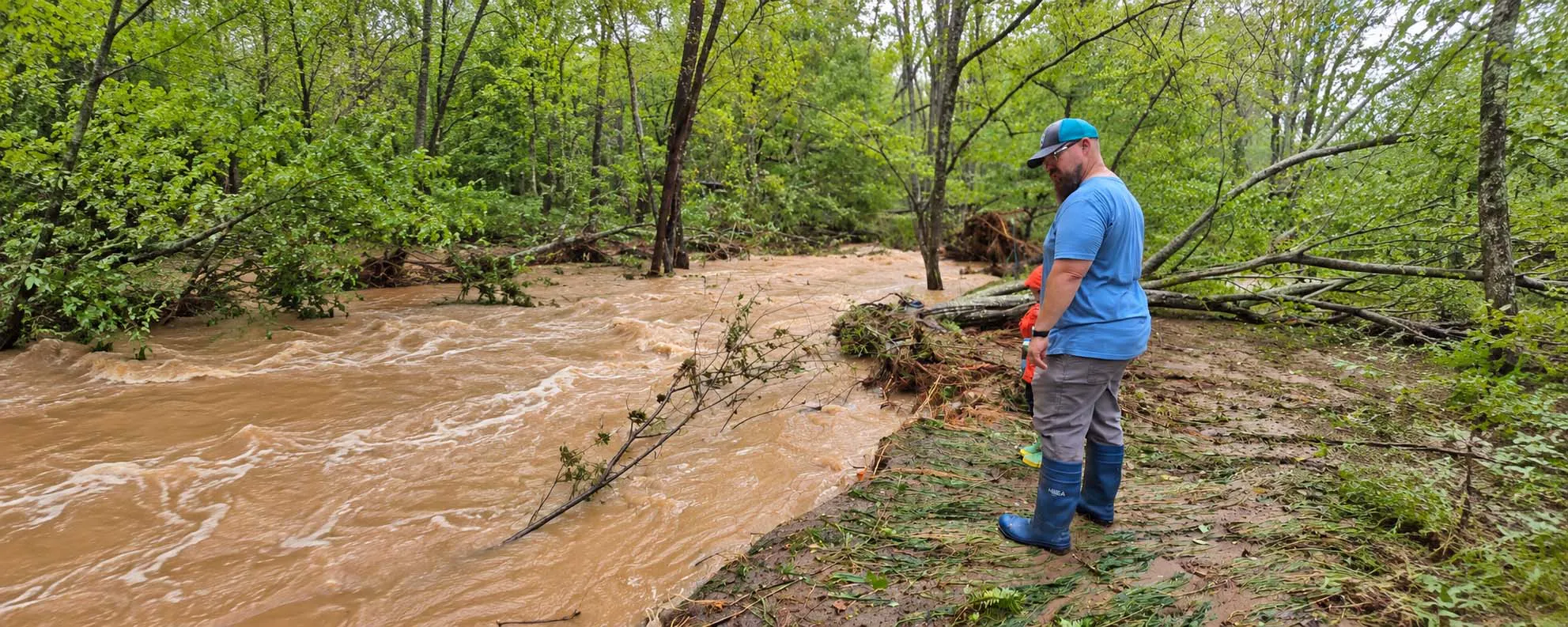
“Normally our creek is three or four feet wide. At the end of the second day, it was to the top of the banks and roaring,” says Erin.
It was loud enough that they could not hear trees coming down through the night.
Then the power went out, and the cell service went with it.
“The scariest part, other than all the water, was losing cell service. You don’t realize how much you depend on it until it’s gone,” Erin says.
As the water kept rising, the family faced a decision with no good answer: stay in the basement and risk the flooding, or go upstairs and risk the trees.
Erin admits, “It’s morbid, but I thought, at least I could clip the ZOLEO to my son if we got washed away. Maybe he’d have a better chance of being found.”
What Hurricane Helene did to western North Carolina
Helene came ashore near Perry, Florida, late on September 26, 2024, as a Category 4 hurricane with maximum sustained winds of 140 mph. By the morning of the 27th, its remnants had reached the southern Appalachians. The National Hurricane Center’s report on the storm records 34 flash flood emergencies issued during the event, 32 of them across the southern Appalachians, with the greatest concentration over western North Carolina.
Weaverville is not a coastal town. It sits near the Blue Ridge Parkway, over 2,000 feet above sea level and roughly 300 miles from the nearest coastline, in an area not commonly expected for natural disasters.
“When we moved to North Carolina, we bought our dream house,” Erin shares. “We’ve got three acres with a small creek that runs through the back.”
“We weren’t even in a flood zone,” Erin explains. “That’s what makes this all so tragic.”
“Nobody realized just how bad it was until it was too late. It caught everyone around here off guard,” she says.
How the family kept the ZOLEO charged for fifteen days without power
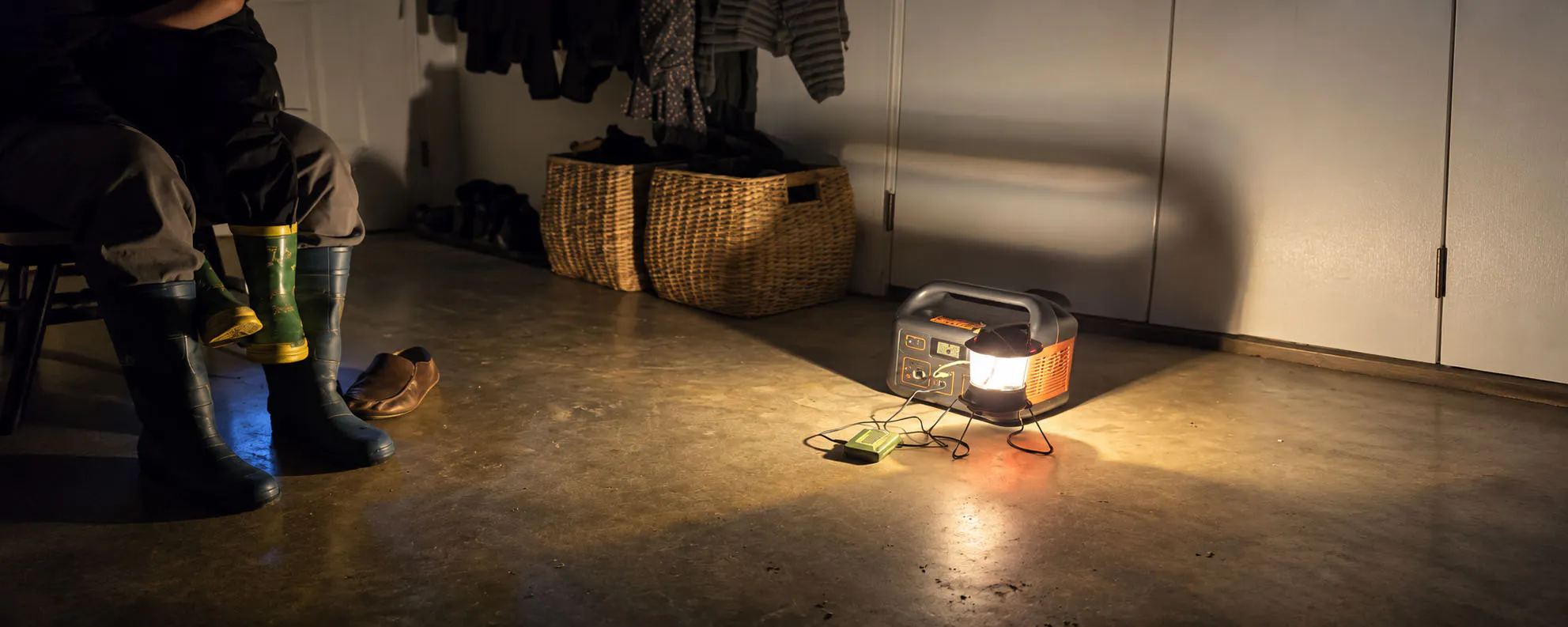
The Gallimores were already equipped, because they camp. They pulled out their camping gear: a camp stove, coolers, freeze-dried food, a solar-panel generator, lanterns, and the ZOLEO.
That solar generator turned out to matter more than anyone expected. Fifteen days without grid power is long enough to flatten every device in a house, and a satellite communicator that runs out of charge is a paperweight.
“During a hurricane, you need a dedicated satellite device, not just a phone with satellite features. The battery lasted days without charging,” Erin says.
In a house where the lights came from a lantern, a device that could go days between charges was the difference between a working line out and another dead screen.
The first satellite messages the Gallimores sent, and who answered
A ZOLEO pairs with a phone over Bluetooth, so messages are typed on the phone and sent by the device over the Iridium satellite network. Satellite messaging needs a clear view of the sky, and dense canopy, deep terrain, nearby structures, and heavy weather can slow a message down or stop it sending until you move.¹
Using the device, the couple could message their friends, family, and work to tell them they were okay. What they sent was not dramatic. It was practical, and then it was affectionate.
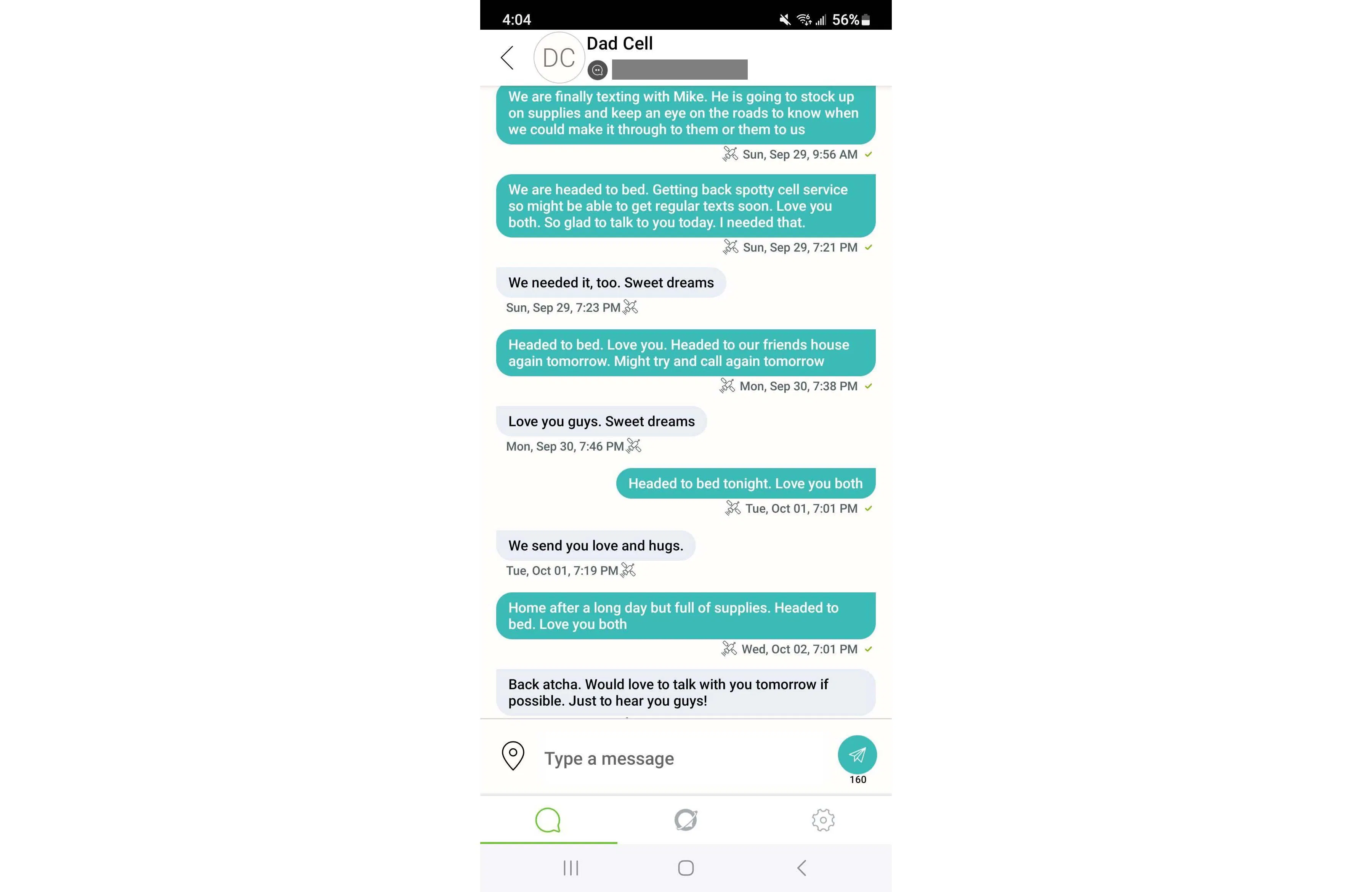
On the morning of September 29, with the roads still closed, Erin used the device to coordinate supplies through a friend:
“We are finally texting with Mike. He is going to stock up on supplies and keep an eye on the roads to know when we could make it through to them or them to us.”
That is the part of a Safety Circle people underestimate. It is not only a line home. It is a way to organize other people while you are stuck.
That evening at 7:21, she wrote:
“We are headed to bed. Getting back spotty cell service so might be able to get regular texts soon. Love you both. So glad to talk to you today. I needed that.”
Her father replied at 7:23.
“We needed it, too. Sweet dreams.”
Cell service came and went over the following days without becoming reliable. It was ten days before it held, and the ZOLEO carried the gaps.
Two minutes. That is the two-way part, and it is the thing a one-way emergency beacon cannot do. Her parents did not need an app or an account to answer. They replied from their own phones to a number they already had.
How a neighbor used the same device to reach her own family
This is the part of the story that has nothing to do with the Gallimores’ own safety.
The Gallimores brought it along to check on their elderly neighbor who lives alone and found her panicked. A tree had fallen and was funneling water into her basement. Using Erin’s ZOLEO and phone, she too was able to send a message to her family, who was concerned about her wellbeing.
One household’s preparation covered two households. The neighbor’s family got the message they had been waiting for because somebody a few hundred yards away had thought about communication before the storm.
Preparedness is usually framed as an individual responsibility. In a disaster it rarely stays that way. The person with a working line out ends up carrying messages for whoever else needs one, and a device bought for hiking with a child became, for an afternoon, the only way to communicate with the outside world for the road.
Why help took four days to reach the Gallimores' road
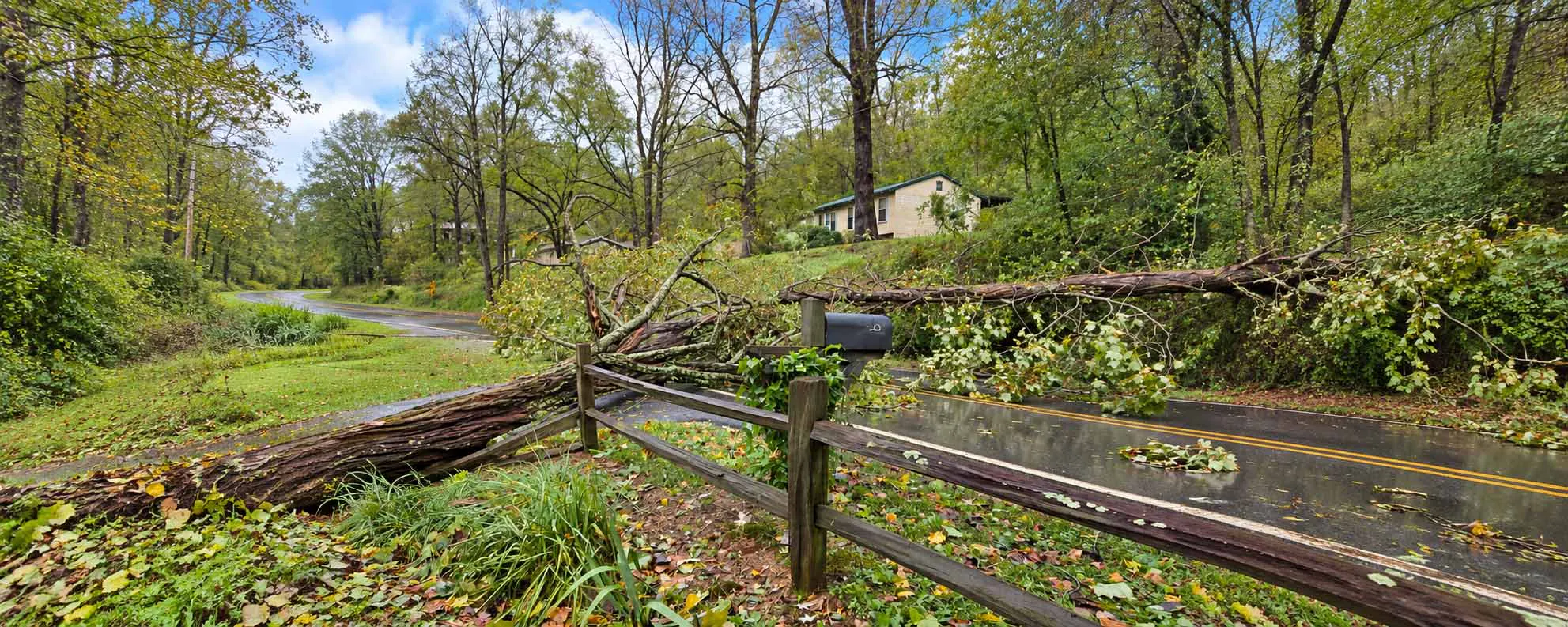
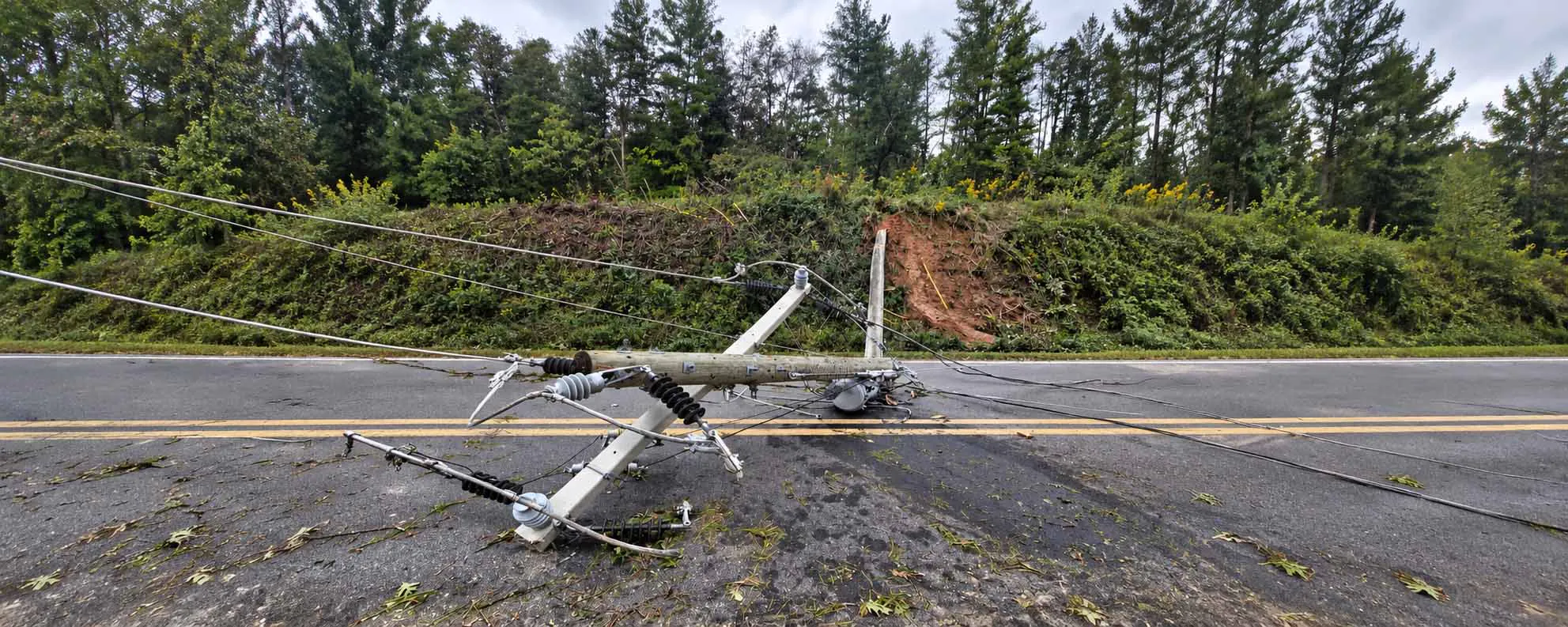
Fallen trees and utility poles closed every road out.
“We kept thinking, ‘Why hasn’t anyone come to help?’” Erin recalls. “Now we know they were trying to rescue people from landslides and out of the river. We couldn’t comprehend how bad things were.”
They had no way of knowing the scale of it. In the three days around the storm, North Carolina’s 911 centers received close to 90,000 emergency calls. More than a hundred storm-related deaths in the state have since been confirmed by the North Carolina Department of Health and Human Services.
It was four days before the family saw any sign of relief: a helicopter overhead, and military trucks at the fire station.
In the meantime, the road got cleared the way most roads did that week, by the people who lived on it.
What ten days of satellite messages to Erin's parents looked like
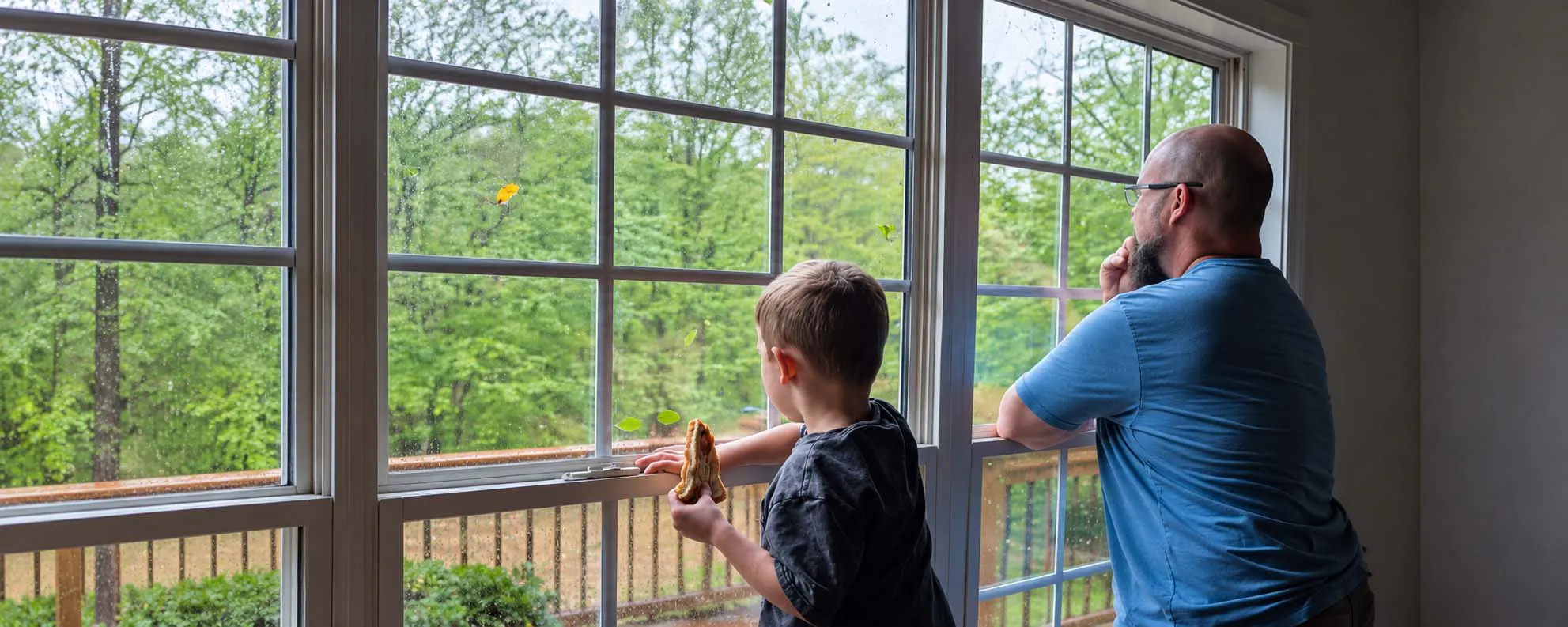
What the thread actually shows, day after day, is a family saying goodnight.
September 30, 7:38 p.m. “Headed to bed. Love you. Headed to our friends house again tomorrow. Might try and call again tomorrow.”
7:46 p.m. “Love you guys. Sweet dreams.”
October 1, 7:01 p.m. “Headed to bed tonight. Love you both.”
7:19 p.m. “We send you love and hugs.”
October 2, 7:01 p.m. “Home after a long day but full of supplies. Headed to bed. Love you both.”
“Back atcha. Would love to talk with you tomorrow if possible. Just to hear you guys!”
“Being able to message my parents out of state was such a relief,” Erin says. “Even sending simple messages like ‘goodnight’ made a difference. I can’t imagine how hard it would have been for us, or for them, not having that connection.”
She recalls others in her community who went days without knowing if their loved ones were okay or even alive.
The family also used the device for something less emotional and just as useful. A ZOLEO can pull a weather forecast over satellite for the device’s location, which counts as one satellite message.
“We were so nervous that more rain was going to come. It was reassuring to check the forecast each day and see that we were in the clear,” Erin says.
What the ZOLEO did during Helene, and what it did not do
It is worth being exact about what the device did here.
The ZOLEO did not get the Gallimores out. Neighbors with chainsaws opened the road, and the water went down on its own schedule. No SOS was sent, and no emergency service was contacted through the device.² The helicopter and the military trucks arrived because of a response effort that had nothing to do with a satellite communicator.
What it did was narrower and, over ten days, not small. It let a family tell the people who loved them that they were alive, every night, from a house with no power and no signal. It let those people answer. It let a neighbor send one message that mattered to her own family. And it let the household check whether more rain was coming.
ZOLEO is a Safety and Preparedness Platform, which means it is one tool in a preparedness plan rather than the plan itself. Satellite communication requires a clear view of the sky and connectivity is not guaranteed.¹ A device is useful in a storm in proportion to the thinking that was done before the storm.
Today the wider Appalachian community is still rebuilding. Residents carry a mix of gratitude, relief, and the weight of having come through something their neighbors did not, and alongside all of it, something steadier.
"It's a sense of community like I've never seen before," Erin concludes.
More accounts from ZOLEO customers are collected on the rescue stories page.
Four things to settle before a storm takes the cell network down
The Gallimores’ experience points at four things worth settling before hurricane season, not during it.
- Decide who needs to hear from you, and how often. Ready.gov’s guidance on building a family communication plan starts here, with an out-of-area contact who can relay for everyone else. Erin's parents were in another state, which is exactly why they could act. Readers outside the United States should use their own national emergency management guidance.
- Make sure those people can reach you, not only the reverse. A one-way emergency beacon sends a distress signal and nothing else. If you want your family to be able to ask a question and get an answer, you need two-way messaging and a number they already have.
- Plan for power before you plan for signal. Fifteen days without grid power will flatten anything. A portable power station or solar generator is what keeps a communicator working past day three.
- Practice once before you need it. Send a message from the device, have someone reply to it, and confirm it arrives. The middle of a storm is a bad time to learn where the sky is clear on your property.
Before the next storm
Make sure your Safety Circle can reach you
Every ZOLEO comes with its own SMS number and email address, so the people who matter can start the conversation from their own phone.
How ZOLEO messaging works →
Frequently Asked Questions
What happens to cell service during a hurricane?
Cell sites lose power, backhaul connections, or the towers themselves. During Hurricane Helene, the FCC’s Disaster Information Reporting System recorded 4,562 cell sites out of service at the peak of the outage, the largest figure in its public record. In the worst-hit counties, restoration took weeks rather than days.
Can you send a text without cell service?
Not over the cellular network. A satellite communicator sends messages over a satellite network instead, which works independently of cell towers, and requires an active subscription.³ It needs a clear view of the sky to send and receive.¹
Does a satellite communicator work indoors or under trees?
Not reliably. Satellite messaging requires a clear view of the sky. Dense canopy, deep terrain, nearby structures, and heavy weather can delay a message or prevent it from sending until you move to more open ground.¹
How do you keep a satellite communicator charged during a long power outage?
The same way you keep anything else charged: a portable power station, a solar generator, or a vehicle. The Gallimores used a solar-panel generator. A ZOLEO 1500 is rated for 200+ hours of battery when checking for messages every 12 minutes in standby with satellite coverage, which means charging is occasional rather than daily.
Is sending a satellite message the same as calling 911?
No. Messaging reaches the people you choose. A separate SOS function alerts an emergency response coordination provider, which is a different action with a different purpose and should be used only in an actual emergency.² The Gallimores never used SOS. They used messaging and weather.
What should a family communication plan include before a storm?
An out-of-area contact, an agreed check-in schedule, at least one way to receive weather alerts that does not depend on the cell network, and a plan for keeping devices charged. Ready.gov publishes templates for the first part.
Sources
Storm data: National Hurricane Center, Tropical Cyclone Report: Hurricane Helene (AL092024). nhc.noaa.gov
Cell site outages: Federal Communications Commission, Communications Status Report for Areas Impacted by Hurricane Helene. docs.fcc.gov
Emergency call volume: Government Technology, Modernized 911 Kept N.C. Connected During Hurricane Helene. govtech.com
Storm-related fatalities: North Carolina Department of Health and Human Services, Hurricane Helene Storm-Related Fatalities. ncdhhs.gov
Family communication planning: Ready.gov, Make a Plan. ready.gov/plan
Device and messaging details: ZOLEO, Getting Started with Satellite Messaging. zoleo.com
Disclaimers
¹ Coverage & Connectivity: Satellite communication requires a clear view of the sky. Connectivity is not guaranteed and may be affected by satellite availability, terrain, weather, environmental conditions, device positioning, and other factors outside ZOLEO’s control. Coverage details apply.
² SOS & Emergency Response Coordination: SOS alerts are monitored by a third-party emergency response coordination provider. ZOLEO is not a licensed emergency dispatch service and does not guarantee rescue, response, evacuation, medical assistance, security assistance, search and rescue availability, or coordination with local emergency authorities. Emergency response, rescue, evacuation, medical, security, and related services are subject to satellite connectivity, applicable laws and regulations, local emergency response capabilities, geographic location, environmental conditions, and third-party service availability. Additional third-party costs may apply. SOS should be initiated only in the event of an actual emergency.
³ Subscription Required: Active subscription required. An active ZOLEO subscription plan is required to transmit messages or use connected features over the Iridium satellite network.
Help Someone Stay Prepared.
Share this with your Safety Circle or the person building the next trip plan, so everyone knows how you will stay connected when the road leaves cell coverage behind.